Practicing Our Piecewise Again Ws #13
Introduction to Piecewise Functions

Piecewise functions (or piece-wise functions) are but what they are named: pieces of different functions (sub-functions) all on i graph. The easiest style to think of them is if you lot drew more than ane function on a graph, and yous just erased parts of the functions where they aren't supposed to be (along the \(x\)'s). Thus, the \(y\)'s are defined differently, depending on the intervals where the \(x\)'southward are.
Note that there is an example of a piecewise office'south changed here in the Inverses of Functions section.
Here's an instance and graph:
| Piecewise Part | Graph |
| \(\displaystyle f\left( ten \right)=\left\{ \begin{align}2x+eight\,\,\,\,\,&\text{ if }x\le -2\\{{x}^{2}}\,\,\,\,\,\,\,\text{ }\,&\text{ if }x>-2\end{align} \correct.\) (There are other ways to brandish this, such equally using a "for" instead of an "if", and using commas or semi-colons instead of the "if".) Domain:\(\mathbb{R},\,\,\,\text{or}\,\,\left( {-\infty ,\infty } \right)\) Range:\(\mathbb{R},\,\,\,\text{or}\,\,\left( {-\infty ,\infty } \right)\) | 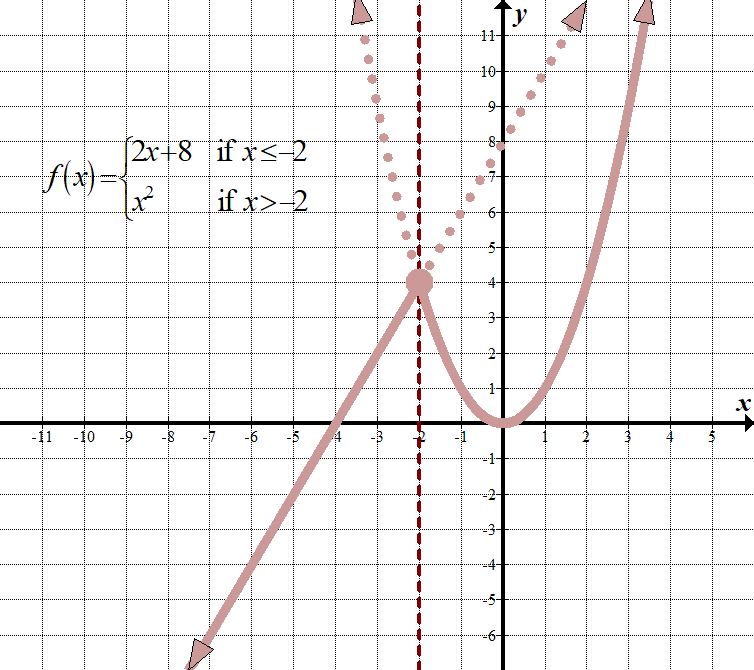 |
What this ways is for every \(x\) less than or equal to –2 , nosotros need to graph the line \(2x+8\), every bit if it were the only role on the graph. For every \(10\) value greater than –ii , we demand to graph \({{x}^{2}}\), every bit if it were the but function on the graph. Then nosotros take to "get rid of" the parts that nosotros don't need.Remember that we even so use the origin as the reference point for both graphs!
Come across how the vertical line \(ten=-2\) acts as a "purlieus" line between the 2 graphs?
Notation that the indicate \((–2,4)\) has a airtight circle on it. Technically, it should only belong to the \(2x+8\) function, since that function has the less than or equal sign, but since the point is besides on the \({{10}^{2}}\) graph, nosotros tin can just utilise a closed circle as if it appears on both functions. See, non then bad, right?
Evaluating Piecewise Functions
Sometimes, you'll be given piecewise functions and asked to evaluate them; in other words, find the \(y\) values when you are given an \(x\) value. Let's exercise this for \(x=-6\) and \(x=4\)(without using the graph).Here is the function again:
\(\displaystyle f\left( 10 \correct)=\left\{ \begin{marshal}2x+8\,\,\,\,\,&\text{ if }x\le -2\\{{10}^{2}}\,\,\,\,\,\,\,\text{ }\,&\text{ if }x>-2\terminate{align} \right.\)
We first desire to wait at the atmospheric condition at the right start, to see where our \(x\)is. When \(10=-6\), nosotros know that it'southward less than –ii , so we plug in our \(x\) to \(2x+eight\) only. \(f(x)\) or \(y\) is \((ii)(-6)+eight=-4\). We don't even care about the \(\boldsymbol{{x}^{two}}\)! Information technology'southward that piece of cake. Y'all can likewise meet that we did this correctly past using the graph above.
Now try \(x=four\). We await at the correct get-go, and see that our \(x\) is greater than –2 , so we plug it in the \({{ten}^{2}}\). (We tin just ignore the \(2x+8\) this fourth dimension.) \(f(x)\) or \(y\) is \({{four}^{two}}=16\).
Graphing Piecewise Functions
You'll probably be asked to graph piecewise functions. Sometimes the graphs will comprise functions that are non-continuous or discontinuous, meaning that you lot have to option up your pencil in the middle of the graph when you are drawing information technology (like a leap!).Continuous functions means that you never have to selection up your pencil if you were to draw them from left to correct.
And remember that the graphs are true functions only if they pass the Vertical Line Test.
Permit's draw these piecewise functions and determine if they are continuous or non-continuous. Note how we depict each role as if it were the only one, and then "erase" the parts that aren't needed. We'll also get the Domain and Range similar nosotros did here in the Algebraic Functions section.
| Piecewise Function | Graph |
| \(\displaystyle f\left( x \right)=\left\{ \begin{array}{l}-2x+8\,\,\,\,\,\,\text{if }x\le 4\\\frac{1}{ii}10-2\,\,\,\,\,\,\,\,\,\text{if }x>4\end{assortment} \right.\) Continuous Domain: \(\mathbb{R},\,\,\,\text{or}\,\,\left( {-\infty ,\infty } \right)\) Range:\(\left( {0,\infty } \right)\) |  |
| \(\displaystyle f\left( x \right)=\left\{ \begin{assortment}{fifty}x+iv\,\,\,\,\,\,\,\,\,\text{if }ten<1\\2\,\,\,\,\,\,\,\,\,\,\,\,\,\,\,\,\,\,\text{if 1}\le x<4\\x-5\,\,\,\,\,\,\,\,\,\text{if }10\ge 4\end{assortment} \right.\) Not-Continuous Domain:\(\mathbb{R},\,\,\,\text{or}\,\,\left( {-\infty ,\infty } \right)\) Range: \(\mathbb{R},\,\,\,\text{or}\,\,\left( {-\infty ,\infty } \right)\) |  |
We tin actually put piecewise functions in the graphing figurer:
| Piecewise Function Screens | Steps and Notes |
| Enter the piecewise function on iii lines: Here'south the graph: | To put the piecewise function\(\displaystyle f\left( x \right)=\left\{ \begin{array}{fifty}x+4\,\,\,\,\,\,\,\,\,\text{if }x<1\\2\,\,\,\,\,\,\,\,\,\,\,\,\,\,\,\,\,\,\,\text{if i }\le x<iv\\-5+ten\,\,\,\,\,\text{if }x\ge 4\cease{array} \right.\) in the computer, you can enter the function on three lines by dividing the role in each interval by a "examination inequality" of that interval (and spotter parentheses!). The reason we carve up by the intervals or inequalities is because the estimator will return a ane if the inequality (such as \(ten<i\)) is true; for example, \((ten+iv)\) will just end up \((x+4)/(1)\) when \(x<one\). When \(10\ge 1\), we are dividing by 0 , so nada will exist drawn. Here is what we can put in the estimator: \(\displaystyle \begin{array}{fifty}{{Y}_{1}}=\left( {x+4} \right)/\left( {ten<1} \right)\\{{Y}_{2}}=\left( 2 \right)/\left( {x\ge 1\text{ and }x<iv} \right)\\{{Y}_{3}}=\left( {-5+x} \correct)/\left( {x\ge iv} \right)\stop{array}\) Note that you can too enter this on one line by multiplying the weather instead of dividing, and using plus signs between each of the three functions/intervals: \(\displaystyle {{Y}_{1}}=\left( {x+4} \correct)\left( {10<one} \correct)+\left( ii \right)\left( {10\ge i\text{ and }10<4} \right)+\left( {-5+x} \right)\left( {ten\ge 4} \right)\). Here are the keystrokes for using 3 lines. Notation that you utilise 2nd MATH (TEST) to get to the screen that has the \(\le \), \(\ge \), and then on. For example, twond MATH 6 gets you \(\le \). Apply 2nd MATH (Test), right to LOGIC, and so 1, for the "and" in \({{Y}_{two}}\). |


How to Tell if Piecewise Part is Continuous or Non-Continuous
To tell if a piecewise graph is continuous or non-continuous, you can await at the boundary points and run into if the \(y\) betoken is the same at each of them. (If the \(y\)'southward were different, there'd be a "bound" in the graph!)
Try this for the functions nosotros used higher up:
| Piecewise Function | Check Boundary Points |
| \(\displaystyle f\left( x \right)=\left\{ \begin{assortment}{l}-2x+viii\,\,\,\,\,\,\,\text{if }x\le four\\\frac{one}{ii}x-2\,\,\,\,\,\,\,\,\,\,\text{if }x>4\end{assortment} \right.\) | Check \(x=4\) in both parts of the role, since 4 is the "boundary signal": \(\begin{array}{l}-2(iv)+8=0\\\,\,\,\frac{1}{2}(four)-2=0\end{array}\) Since \(0=0\), this piecewise function is continuous. |
| \(\displaystyle f\left( x \correct)=\left\{ \brainstorm{array}{l}x+4\,\,\,\,\,\,\,\,\,\,\,\,\,\text{if }ten<1\\2\,\,\,\,\,\,\,\,\,\,\,\,\,\,\,\,\,\,\,\,\,\,\,\text{if ane }\le x<4\\-5+ten\,\,\,\,\,\,\,\,\,\text{if }x\ge 4\end{array} \right.\) | Bank check \(x=i\) in the first two parts of the role. Note in the 2nd function, \(y\) is ever 2 : \(\brainstorm{assortment}{l}1+4=5\\\,\,\,\,\,\,\,\,\,ii=2\end{array}\) Since \(5\ne 2\), we can stop here, and note that this piecewise office is non-continuous. If the \(y\)'s were equal, we'd have to get i to check the side by side boundary point at \(x=iv\). |
Obtaining Equations from Piecewise Function Graphs
You may exist asked to write a piecewise part, given a graph. Now that we know what piecewise functions are all near, it's not that bad! To review how to obtain equations from linear graphs, see Obtaining the Equations of a Line, and from quadratics, meet Finding a Quadratic Equation from Points or a Graph.
Here are the graphs, with explanations on how to derive their piecewise equations:
| Piecewise Function Graph | Procedure to get Role |
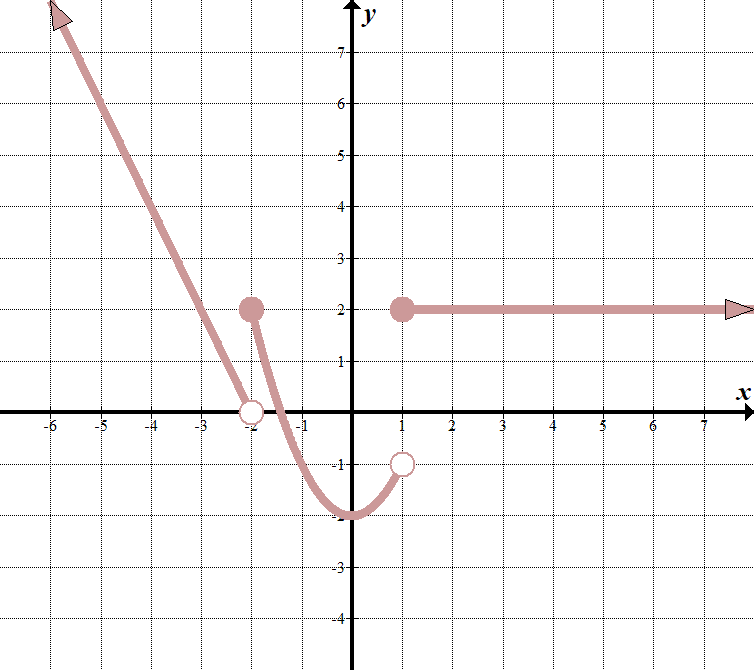 | We see that our "purlieus lines" are at \(x=-two\) and \(x=i\). We know that our function will await something like this (notice open and airtight endpoints): \(\displaystyle f\left( x \right)=\left\{ \brainstorm{array}{l}\text{ }……\,\,\,\,\,\,\,\,\text{if }x<-2\\\text{ }……\,\,\,\,\,\,\,\,\text{if }-\text{two }\le 10<1\\\text{ }……\,\,\,\,\,\,\,\,\text{if }x\ge 1\end{assortment} \right.\) Pick two points \((–2,0)\) and \((–3,two)\) on the leftmost line to get the equation \(y=-2x-four\). The middle part is \(y={{x}^{2}}-2\), and the rightmost function is simply the horizontal line \(y=2\). Thus, the piecewise function is: \(\displaystyle f\left( x \correct)=\left\{ \begin{array}{l}-2x-iv\,\,\,\,\,\,\,\text{if }x<-2\\\text{ }{{10}^{2}}-2\,\,\,\,\,\,\,\,\,\,\text{if }-\text{2}\le x<1\\\text{ 2}\,\,\,\,\,\,\,\,\,\,\,\,\,\,\,\,\,\,\,\,\,\,\text{if }x\ge 1\stop{array} \right.\) |
 | We see that our "purlieus line" is at \(x=5\). Since the lines meet at \((5,4)\), information technology doesn't matter where we put the \(\le \) or \(\ge \) sign; we just can't put information technology both places, or it wouldn't be a role. We take so far: \(\displaystyle f\left( x \correct)=\left\{ \brainstorm{array}{l}\text{ }……\,\,\,\,\,\,\,\,\,\text{if }ten<5\\\text{ }……\,\,\,\,\,\,\,\,\,\text{if }x\ge 5\stop{array} \right.\) Again, we take to look at each line separately to determine their equations. Either take 2 points from each line to become these, or derive from slopes and \(y\) – intercepts; the piecewise function is: \(\displaystyle f\left( x \right)=\left\{ \begin{array}{l}\frac{half dozen}{5}x-2\,\,\,\,\,\,\,\text{if }10<v\\\frac{2}{5}x+two\,\,\,\,\,\,\,\text{if }x\ge five\terminate{array} \right.\) |
Accented Value as a Piecewise Function
You may be asked to write an absolute value function as a piecewise role. You might want to review Solving Absolute Value Equations and Inequalities earlier continuing on to this topic.
Let's say we have the function\(f\left( 10 \right)=\left| x \correct|\). From what we learned before, we know that when \(ten\) is positive, since we're taking the absolute value, it will still only be \(x\). But when \(x\) is negative, when we take the absolute value, we have to take the opposite (negate it), since the absolute value has to be positive. Make sense? So, for example, if we had \(|5|\), nosotros just have what's inside the accented sign, since information technology'due south positive. But for \(|–5|\), we have to take the contrary (negative) of what's inside the absolute value to make information technology \(\displaystyle five\,\,(–v=5)\).
This means nosotros tin can write this absolute value function as a piecewise function. Notice that nosotros tin can become the "turning bespeak" or "boundary signal" by setting whatever is inside the absolute value to 0. So we'll either use the original function, or negate the part, depending on the sign of the role (without the absolute value) in that interval.
For example, we can write \(\displaystyle \left| 10 \right|=\left\{ \begin{array}{l}x\,\,\,\,\,\,\,\,\,\text{if }10\ge 0\\-x\,\,\,\,\,\text{if }10<0\end{assortment} \right.\). Besides note that, if the function is continuous (there is no "jump") at the boundary point, it doesn't matter where we put the "less than or equal to" (or "greater than or equal to") signs, as long as nosotros don't repeat them! We tin can't repeat them because, theoretically, nosotros can't have 2 values of \(y\) for the same \(10\), or nosotros wouldn't have a function.
Hither are more examples, with explanations. Yous can also check these in the graphing calculator using \({{Y}_{one}}=\) and MATH NUM 1 (abs). (You might want to review Quadratic Inequalities for the second instance beneath):
| Absolute Value Role | Method to get Piecewise Function |
| \(g\left( x \right)=\left| {2x+three} \right|\) | First find the "purlieus line". We do this by setting what'due south inside the absolute value to 0, and then solving for \(\boldsymbol{ten}\). When \(2x+iii\ge 0\), we get \(\displaystyle x\ge -\frac{iii}{two}\) (actually, we can go on the \(\ge \) when we solve). When \(2x+3\) is positive (non-negative, actually), we just take information technology "every bit is", but if it's negative, we accept to negate the whole thing. Therefore, the piecewise function is: \(\displaystyle \left| {2x+3} \right|=\left\{ \brainstorm{array}{l}2x+3\,\,\,\,\,\,\,\,\,\text{if }10\ge -\frac{three}{2}\text{ }\\-2x-3\,\,\,\,\,\text{if }x<-\frac{3}{two}\end{array} \right.\) Try it – information technology works! |
| \(f\left( x \correct)=\left| {{{10}^{2}}-4} \right|\) | First observe the "purlieus line(s)"; nosotros prepare what'due south within the absolute value to 0 . When \({{10}^{2}}-4\ge 0\), we go \(x\le -2\) or \(x\ge 2\) (try some numbers!). When \({{10}^{2}}-4\) is positive (not-negative, actually), we just take it "as is", just if it'due south negative, nosotros accept to negate it. The piecewise function is: \(\displaystyle \left| {{{10}^{2}}-4} \right|=\left\{ \begin{array}{l}{{x}^{2}}-4\,\,\,\,\,\text{if }x\le -2\\4-{{x}^{2}}\,\,\,\,\,\text{if }-2<x<2\\{{x}^{two}}-four\,\,\,\,\,\text{if }ten\ge 2\text{ }\end{array} \right.\) or \(\displaystyle \left| {{{x}^{2}}-iv} \right|=\left\{ \begin{assortment}{fifty}{{ten}^{2}}-4\,\,\,\,\,\,\text{if }10\le -2\text{ }\,\,\text{or}\,\,\text{ }x\ge 2\\4-{{ten}^{ii}}\,\,\,\,\,\,\,\text{if }-2<10<2\end{assortment} \right.\) Once more (since the function is continuous), information technology really doesn't matter where we have the \(\le \) and \(\ge \) (as opposed to \(<\) and \(>\)), every bit long as we don't repeat them. |
| \(f\left( x \right)=2x+\left| {ten+two} \right|\) | This one'southward a little trickier, since we have an \(x\) inside and outside the absolute value. For the "purlieus line", we simply employ what is inside the accented value. When \(x+2\ge 0\), we get \(10\ge -2\). When \(x+2\) is positive (non-negative, actually) (\(x\ge -2\)), nosotros merely take it "as is", but if it's negative, nosotros have to negate it to make it \(-x-2\). For the piecewise function, nosotros take to use the whole function, including the part that's exterior the accented value. And then, the piecewise office is: \(\displaystyle 2x+\left| {x+2} \right|=\left\{ \begin{array}{l}2x+x+two\,\,\,\,\,\text{if }ten\ge -2\\2x-x-2\,\,\,\,\,\text{if }10<-two\finish{array} \right.\) Simplify: \(\displaystyle 2x+\left| {x+two} \right|=\left\{ \begin{array}{l}3x+2\,\,\,\,\,\,\,\text{if }x\ge -2\\10-2\,\,\,\,\,\,\,\,\,\,\text{if }x<-2\cease{array} \correct.\) Attempt some values less than and cracking so –2 ; they should work! |
| \(yard\left( x \right)=\left| {{{x}^{2}}-4x-5} \right|\) | This i is best solved with a sign chart since we have a quadratic and we need to know where the function is positive and negative. Starting time, factor the quadratic inside the absolute value function to \(\left( {10-5} \right)\left( {x+1} \correct)\). Then employ a sign chart to see where the factors are positive and negative, and remember that where the factors are positive (non-negative, actually), we employ the function "equally is", and where the factors are negative, we negate the function: \(\displaystyle \left| {{{ten}^{2}}-4x-5} \right|=\left\{ \brainstorm{array}{50}{{x}^{2}}-4x-5\,\,\,\,\,\,\,\,\,\,\,\,\,\text{if }x\le -1\,\,\,\,\text{or}\,\,\,\,x\ge 5\\-{{ten}^{ii}}+4x+5\,\,\,\,\,\,\,\,\,\text{if }-1<x<5\text{ }\finish{assortment} \correct.\) |
| \(\displaystyle g\left( x \correct)=\frac{{\left| {x+2} \right|}}{{x+2}}\) | This is a rational function, since at that place's a variable in the denominator. When \(x+2\ge 0\), we get \(\displaystyle x\ge -2\). When \(ten+2\) is positive (not-negative, actually), we simply take it "as is", only if information technology'southward negative, we accept to negate what'southward in the accented value: \(\displaystyle \frac{{\left| {x+ii} \right|}}{{10+2}}=\left\{ \begin{array}{50}\frac{{10+two}}{{ten+2}}\,\,(=1)\,\,\,\,\,\,\,\,\,\,\,\,\,\text{if }x\ge -2\\\frac{{-x-2}}{{x+ii}}\,\,(=-1)\,\,\,\,\,\,\text{if }10<-ii\cease{array} \right.\). But nosotros take to exist careful, since \(ten\ne 2\) (domain brake: the denominator would be 0 ). Therefore, the piecewise function is: \(\displaystyle \frac{{\left| {x+2} \right|}}{{x+2}}=\left\{ \begin{assortment}{50}one\,\,\,\,\,\,\,\,\,\,\text{if }x>-two\\-one\,\,\,\,\,\,\text{if }ten<-two\end{array} \correct.\). |

You may besides be asked to take an absolute value graph and write it as a piecewise function:
| Absolute Value Graph | Method to get Piecewise Office |
 | We run across that our "boundary line" is at \(10=0\), so what's inside the absolute value sign must exist \(x\) or a factor of \(x\). (This is because to get the boundary line with an absolute value role, we set up what'south inside the absolute value to 0 , and solve for \(x\)). When \(x>0\), we can come across that the equation of the line is \(y=2x-ii\). When \(x<0\), the equation is \(y=-2x-2\). We can write this as a piecewise function: \(\displaystyle f\left( 10 \correct)=\left\{ \brainstorm{array}{fifty}2x-2\,\,\,\,\,\,\,\text{if }x>0\\-2x-2\,\,\,\text{if }x\le 0\terminate{array} \right.\) We tin can likewise write this every bit a transformed absolute value part: \(y=2\left| ten \correct|-2\) or \(y=\left| {2x} \right|-ii\) (since 2 is positive, it can be inside or outside the \(\left| {\,\,} \right|\)). (This makes sense since when what's inside the \(\left| {\,\,} \right|\) is \(> 0\), we use the regular function \(y=2x-2\), and when what's inside the is \(< 0\), we negate the absolute value office to make it \(y=-\left( {2x} \right)-2\)). |
 | We encounter that our "boundary lines" are at \(x=2\) and \(ten=-2\), so what'due south within the absolute value sign must have factors of \(x-2\) and \(x+ii\). When \(x<-2\) or \(x>two\), we can encounter that the graph looks like the normal part of the graph \(y={{10}^{two}}-four\). (I figured this out past knowing the factors, and taking a good guess!) When \(-2<x<2\), the equation \(y={{x}^{2}}-4\) is flipped, or negated (flipped over the \(x\)-axis). Nosotros tin can write this equally a piecewise function: \(\displaystyle f\left( x \correct)=\left\{ \brainstorm{assortment}{50}{{10}^{ii}}-iv\,\,\,\,\,\,\,\,\,\text{if }x<-2\text{ or }10>2\\-{{x}^{ii}}\text{+ four}\,\,\,\,\,\,\text{if }-2\le ten\le ii\end{array} \right.\) We tin can encounter that this started out a transformed quadratic function \(y={{x}^{2}}-4\) with an accented value effectually information technology, since all \(y\) values are positive: \(y=\left| {{{x}^{two}}-4} \correct|\). |
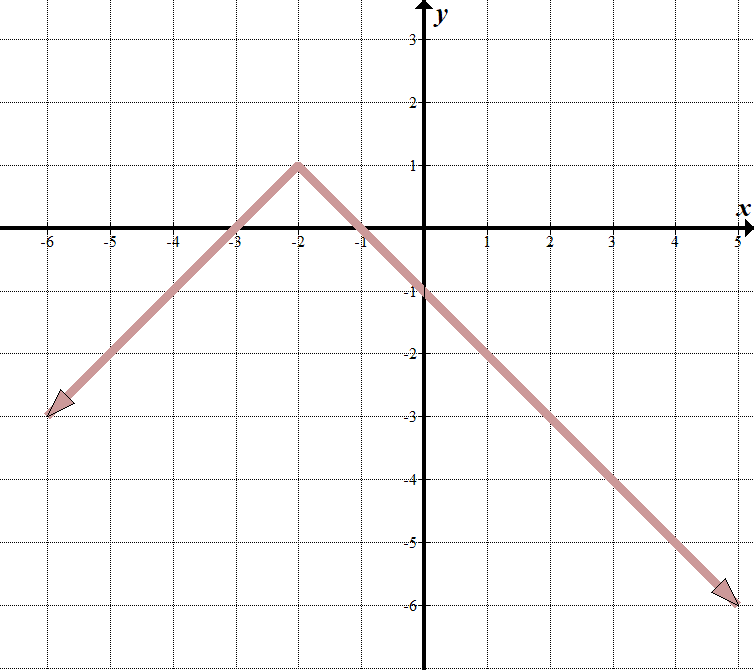 | We see that our "boundary line" is at \(10=-2\), so what's inside the accented value sign must be \(ten+2\). When \(x>-2\), we tin can see that the equation of the line is \(y=-x-ane\). When \(x<-2\), the line is \(y=x+three\). We can write this as a piecewise function: \(\displaystyle f\left( ten \right)=\left\{ \brainstorm{array}{l}-x-1\,\,\,\,\,\,\text{if }x>-2\\x+3\,\,\,\,\,\,\,\,\,\,\text{if }x\le -ii\terminate{array} \right.\) It's probably easier to write this as a transformed absolute value function. We tin can see that the parent absolute value role is flipped vertically, move to the left ii , and up 1 . Our accented value equation is \(y=-\left| {x+2} \right|\,\,+\,\,1\). This is the same equally the piecewise function higher up. Endeavour it – information technology works! |
Transformations of Piecewise Functions
Allow'southward do a transformation of a piecewise office. We learned how about Parent Functions and their Transformations here in the Parent Graphs and Transformations section. You'll probably desire to read this department showtime, earlier trying a piecewise transformation. Permit'south transform the following piecewise role flipped around the \(10\)-axis, vertically stretched by a factor of two units, ane unit of measurement to the right, and 3 units up.
So, let's describe \(-2f\left( x-1 \correct)+three\), where:
\(\displaystyle f\left( x \right)=\left\{ \begin{marshal}ten+4\,\,\,\,\,\,\,\,&\text{ if }ten<one\\two\,\,\,\,\,\,\,\,&\text{ if 1 }\le 10<4\\ten-5\,\,\,\,\,\,\,\,&\text{ if }10\ge 4\finish{align} \right.\)
Make certain to use the "purlieus" points when we make full in the t-chart for the transformation. Remember that the transformations inside the parentheses are done to the \(x\) (doing the opposite math), and outside are done to the \(y\). To come up with a t-chart, every bit shown in the table below, we can use key points, including two points on each of the "purlieus lines".
Note that considering this transformation is complicated, we can come upwards with a new piecewise function by transforming the three "pieces" and also transforming the "\(10\)"south where the boundary points are (adding 1 , or going to the right 1 ), since we do the opposite math for the "\(x\)"south. To get the new functions in each interval, nosotros can just substitute "\(x-1\)" for "\(10\)" in the original equation, multiply by –ii , and then add iii . For example, for the first function of the piecewise function, \(\displaystyle -2f\left( {x-1} \correct)+iii=-2\left[ {\left( {ten-ane} \right)+4} \right]+three=-ii\left( {x+3} \correct)+3=-2x-three\). So we accept:
\(\displaystyle -2f\left( {ten-1} \right)+iii=\left\{ \begin{assortment}{l}-2\left( {\left( {x-one} \correct)+4} \right)+three=-2x-iii,\,\,\,\,\text{ }\,\,\text{ if }x-1<1\,\,\,\,\left( {x<2} \right)\\-2\left( two \correct)+three=-1,\,\,\,\,\text{ }\,\,\,\,\,\,\,\,\,\,\,\,\,\,\,\,\,\,\,\,\,\,\,\,\,\,\,\,\,\,\,\,\,\,\,\,\,\,\,\text{ if }\,\text{ ii }\le ten<5\\-2\left( {\left( {10-1} \right)-v} \correct)+3=-2x+15,\,\,\,\,\,\,\text{ if }x\ge 5\cease{array} \correct.\)
Here are the "earlier" and "after" graphs, including the t-nautical chart:
| Piecewise Parent Part | T-chart | Transformation of Function | ||||||||||||||||||||||||||||||||||||||||
| \(\displaystyle f\left( x \right)=\left\{ \begin{array}{l}x+4\,\,\,\,\,\,\,\,\text{if }x<1\\2\,\,\,\,\,\,\,\,\,\,\,\,\,\,\,\,\,\,\text{if 1 }\le x<4\\ten-v\,\,\,\,\,\,\,\,\text{if }x\ge four\finish{assortment} \right.\) |
| \(\displaystyle -2f\left( {ten-1} \correct)+3=\left\{ \begin{array}{l}-2x-iii\,\,\,\,\,\,\,\,\,\text{if }x<2\\-1\,\,\,\,\,\,\,\,\,\,\,\,\,\,\,\,\,\,\,\,\,\text{if 2}\le 10<v\\-2x+15\,\,\,\,\,\,\text{if }x\ge v\terminate{array} \right.\) | ||||||||||||||||||||||||||||||||||||||||


Piecewise Function Give-and-take Problems
 Problem:
Your favorite dog groomer charges according to your dog's weight. If your dog is 15 pounds and under, the groomer charges $35 . If your dog is between fifteen and twoscore pounds, she charges $forty . If your dog is over 40 pounds, she charges $40 , plus an additional $2 for each pound.
(a) Write a piecewise function that describes what your canis familiaris groomer charges. (b) Graph the function. (c) What would the groomer charge if your dog weighs 60 pounds?
Solution:
(a) We encounter that the "boundary points" are fifteen and 40 , since these are the weights where prices change. Since nosotros have two boundary points, we'll have 3 equations in our piecewise function. We take to start at 0 , since dogs take to weigh over 0 pounds:
\(\displaystyle f\left( ten \right)=\left\{ \brainstorm{assortment}{l}\text{ }……\,\,\,\,\,\,\,\,\,\text{if }0<10\le 15\\\text{ }……\,\,\,\,\,\,\,\,\,\text{if }15<x\le 40\\\text{ }……\,\,\,\,\,\,\,\,\,\text{if }x>40\end{array} \correct.\)
We are looking for the "answers" (how much the preparation costs) to the "questions" (how much the canis familiaris weighs) for the three ranges of prices. The start 2 are just flat fees ( $35 and $40 , respectively). The final equation is a little trickier; the groomer charges $40 plus $2 for each pound over 40 . Let's try real numbers: if your canis familiaris weighs threescore pounds, she will charge $40 plus $2 times \(20\,\,(60–40)\). We'll turn this into an equation: \(xl+2(x–twoscore)\), which simplifies to \(2x–40\) (run into how 2 is the slope?).
The whole piecewise role is:
\(\displaystyle f\left( x \right)=\left\{ \brainstorm{assortment}{l}\text{ }35\,\,\,\,\,\,\,\,\,\,\,\,\,\,\,\,\,\,\,\,\,\,\,\,\,\,\,\,\,\,\,\,\,\,\,\,\text{if }0<x\le 15\\\text{ }twoscore\,\,\,\,\,\,\,\,\,\,\,\,\,\,\,\,\,\,\,\,\,\,\,\,\,\,\,\,\,\,\,\,\,\,\,\,\text{if }15<x\le 40\\\text{ }40+2\left( {x-forty} \right)\,\,\,\,\,\,\text{if }x>twoscore\end{array} \correct.\) or \(\displaystyle f\left( 10 \right)=\left\{ \begin{array}{l}\text{ }35\,\,\,\,\,\,\,\,\,\,\,\,\,\,\,\,\,\,\,\text{if }0<10\le 15\\\text{ }40\,\,\,\,\,\,\,\,\,\,\,\,\,\,\,\,\,\,\,\text{if }fifteen<10\le twoscore\\\text{ }2x-40\,\,\,\,\,\,\,\text{if }x>40\end{array} \right.\)
(b) Let's graph: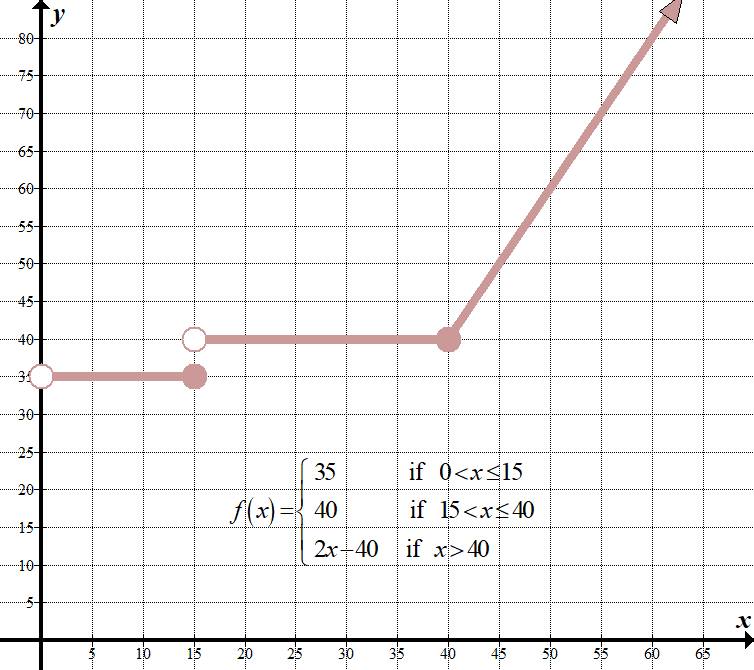 Note that this piecewise equation is not-continuous. Too notation a reasonable domain for this problem might be \(\left( {0,200} \right]\) (given dogs don't counterbalance over 200 pounds!) and a reasonable range might be \(\left[ {35} \correct]\cup \left[ {40,360} \correct]\).
(c) If your dog weighs 60 pounds, we tin can either apply the graph, or the function to run into that you would have to pay $eighty .
Trouble:
Yous plan to sell t-shirts as a fundraiser. The wholesale t-shirt visitor charges you $10 a shirt for the first 75 shirts. After the starting time 75 shirts you purchase up to 150 shirts, the company volition lower its price to $7.50 per shirt. After you purchase 150 shirts, the cost will decrease to $v per shirt. Write a function that models this situation.
Solution:
Nosotros come across that the "boundary points" are 75 and 150 , since these are the number of t-shirts bought where prices change. Since we have two purlieus points, we'll take three equations in our piecewise role. We'll outset with \(x\ge 1\), since, nosotros assume at least 1 shirt is bought. Annotation in this problem, the number of t-shirts bought (\(ten\)), or the domain, must be a integer, only this restriction shouldn't affect the outcome of the trouble.
\(\displaystyle f\left( 10 \correct)=\left\{ \begin{array}{l}\text{ }……\text{ if }1\le x\le 75\\\text{ }……\text{ if }75<x\le 150\\\text{ }……\text{ if }x>150\cease{array} \right.\)
We are looking for the "answers" (total toll of t-shirts) to the "questions" (how many are bought) for the 3 ranges of prices.
For up to and including 75 shirts, the price is $10 , so the total price would \(10x\). For more than 75 shirts but up to 100 shirts, the cost is $7.50 , but the first 75 t-shirts volition still cost $10 per shirt. The 2d function includes the $750 spent on the first 75 shirts ( 75 times $10 ), and also includes $7.50 times the number of shirts over 75 , which would be \((x-75)\). For example, if you bought 80 shirts, you'd have to spend \(\$10\times 75=\$750\), plus \(\$7.50\times 5\,\) (80 – 75) for the shirts after the 75th shirt.
Similarly, for over 150 shirts, we would still pay the $10 cost up through 75 shirts, the $7.50 price for 76 to 150 shirts ( 75 more shirts), and and so $five per shirt for the number of shirts bought over 150 . We'll pay \(10(75)+7.50(75)+v(x-150)\) for \(x\) shirts. Put in numbers and try it!
The whole piecewise function is:
\(\displaystyle f\left( ten \right)=\left\{ \begin{assortment}{fifty}\text{ }10x\text{ }\,\,\,\,\,\,\,\,\,\,\,\,\,\,\,\,\,\,\,\,\,\,\,\,\,\,\,\,\,\,\,\,\,\,\,\,\,\,\,\,\,\,\,\,\,\,\,\,\,\,\,\,\,\,\,\,\,\,\,\,\,\,\,\,\,\,\text{if }i\le 10\le 75\\\text{ 10}\left( {75} \right)+7.five\left( {x-75} \right)\text{ }\,\,\,\,\,\,\,\,\,\,\,\,\,\,\,\,\,\,\,\,\,\,\text{ if 7}5<x\le 150\\\text{ x}\left( {75} \right)+7.5\left( {75} \right)+v\left( {x-150} \correct)\text{ }\,\text{if }x>150\end{array} \right.\) or \(\displaystyle f\left( x \right)=\left\{ \begin{assortment}{l}\text{ }10x\,\,\,\,\,\,\,\,\,\,\,\,\,\,\,\,\,\,\,\,\,\,\,\,\,\,\,\text{if }i\le ten\le 75\\\text{ }7.5x\text{ }+\text{ }187.5\,\,\,\,\,\text{if 7}v<x\le 150\\\text{ }5x+562.5\,\,\,\,\,\,\,\,\,\,\,\text{if }ten>150\end{assortment} \right.\)
Problem:
A autobus service costs $50 for the first 400 miles, and each additional 300 miles (or a fraction thereof) adds $10 to the fare. Utilise a piecewise role to represent the bus fare in terms of the distance in miles.
Solution:
This is actually a tricky problem, but let'due south commencement call back starting time nearly the "boundary point", which is 400 . It's pretty straightforward when the ride is less than 400 miles; the toll is $l .
For greater than 400 miles, we accept to subtract out the kickoff 400 miles (only remember to include the outset $50 ), divide the number of miles left past 300 miles (and round up, if there'southward a fractional amount), and multiply that by $10 .
The tricky office is when nosotros "circular up" for a portion of the next 300 miles. We tin can use a "ceiling" office (designated by \(\left\lceil {} \right\rceil \)); this function gives the least integer that is greater than or equal to its input; for case, the ceiling of both 3.5 and 4 is 4 .
Thus, this is what nosotros have:
\(\displaystyle f\left( x \right)=\left\{ \brainstorm{array}{l}\text{ }fifty\text{ }\,\,\,\,\,\,\,\,\,\,\,\,\,\,\,\,\,\,\,\,\,\,\,\,\,\,\,\,\,\,\,\,\,\,\,\,\,\,\,\,\,\,\,\,\,\,\,\,\,\,\,\text{if }0\le ten\le 400\\\text{ }50+\left( {10\times \left\lceil {\frac{{x-400}}{{300}}} \correct\rceil } \right)\text{ }\,\,\,\,\,\text{ if }x>400\end{array} \right.\)
Let'due south try information technology! If we have a 1500 -mile ride, the toll would be \(\displaystyle fifty+\left( {ten\times \left\lceil {\frac{{1500-400}}{{300}}} \correct\rceil } \right)\text{ }=50+\left( {x\times 4} \right)=\$xc\).
Problem:
What value of \(\boldsymbol{a}\) would brand this piecewise function continuous?
\(\displaystyle f\left( ten \right)=\left\{ \begin{array}{fifty}3{{x}^{2}}+4\,\,\,\,\,\text{ if }x<-2\\5x+\boldsymbol{a}\,\,\,\,\,\,\,\,\text{if }x\ge -two\cease{array} \right.\)
Solution:
For the piecewise function to be continuous, at the purlieus point (where the function changes), the two \(y\) values must be the same. Nosotros can plug in –2 for \(ten\) in both of the functions and make certain the \(y\)'s are the same
\(\begin{align}3{{x}^{two}}+4&=5x+a\\three{{\left( {-ii} \correct)}^{2}}+4&=5\left( {-2} \right)+a\\12+4&=-ten+a\\a&=26\terminate{align}\)
If \(a=26\), the piecewise function is continuous!
Learn these rules, and practise, practice, practice!
More Do: Apply the Mathway widget beneath to try write a Piecewise Office. Click on Submit (the blue pointer to the right of the problem) and click on Write the Absolute Value equally Piecewiseto see the answer.
Y'all tin can besides type in your own problem, or click on the iii dots in the upper correct mitt corner and click on "Examples" to drill down by topic.
If you click on Tap to view steps, or Click Hither, you lot can annals at Mathway for a free trial, and and then upgrade to a paid subscription at whatsoever time (to get any type of math problem solved!).
On to Matrices and Solving Systems with Matrices – you are ready!
Source: https://mathhints.com/piecewise-functions/
0 Response to "Practicing Our Piecewise Again Ws #13"
Post a Comment